


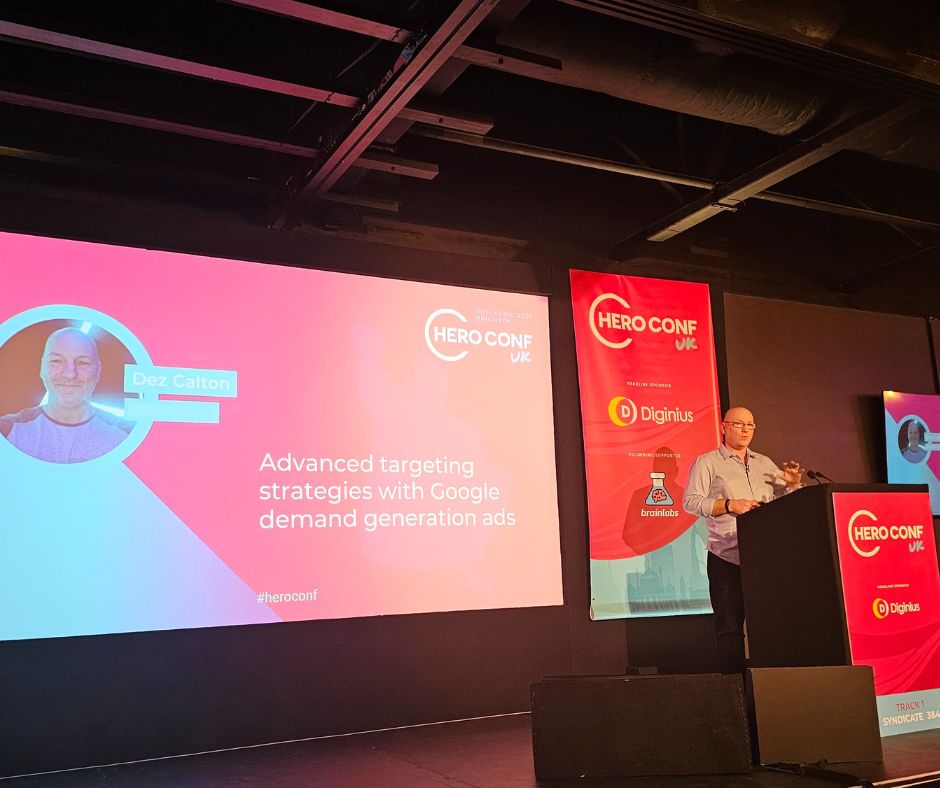
Earlier this year at Hero Conf UK, our founder Dez Calton took to the stage to share one of his specialist areas, how to unlock the full potential of Google Demand Generation Ads through advanced targeting.
You can watch the full Hero Conf session below:
You can watch the full Hero Conf session below:
These campaigns are still relatively new to many advertisers, yet they’ve quickly become a quiet powerhouse for awareness, mid-funnel engagement, and even lead generation when used strategically.
In this post, we’ll recap some of Dez’s key insights and explain why Demand Gen deserves a place in every performance marketer’s toolkit.
In this post, we’ll recap some of Dez’s key insights and explain why Demand Gen deserves a place in every performance marketer’s toolkit.
From Discovery to Demand Gen: A New Era of Reach and Relevance
Google first introduced Discovery Ads in 2019, appearing across Gmail, YouTube’s Home feed, and the Google Discover app. They offered something fresh, a more native, visually-led experience compared to traditional Display ads.
In 2023, Google evolved these into Demand Generation Ads, expanding placements to YouTube Shorts, in-feed and in-stream video, and eventually the Google Display Network. Alongside these broader placements came video creatives and more refined audience targeting, improved creative flexibility, and better performance insights.
The result? A format that bridges the gap between performance marketing and storytelling, blending reach, intent, and automation.
In 2023, Google evolved these into Demand Generation Ads, expanding placements to YouTube Shorts, in-feed and in-stream video, and eventually the Google Display Network. Alongside these broader placements came video creatives and more refined audience targeting, improved creative flexibility, and better performance insights.
The result? A format that bridges the gap between performance marketing and storytelling, blending reach, intent, and automation.
Demand Generation Ad on YouTube

First-Party Data: Your Most Valuable Targeting Asset
One of the biggest shifts in modern advertising is the move toward first-party data. With privacy changes and cookie deprecation, your CRM, website, and app data have become essential for building competitive targeting strategies.
Demand Gen campaigns allow advertisers to create granular audience segments, people who’ve signed up, purchased, or engaged with your brand. You can also build lookalikes to find similar high-intent users across YouTube, Gmail, Discover and the GDN.
These segments aren’t just for inclusion. You can also exclude recent converters or low-value leads to maintain efficiency and reduce wasted impressions.
As Dez shared in his talk, “your own data becomes the foundation of smarter, cleaner targeting.”
Demand Gen campaigns allow advertisers to create granular audience segments, people who’ve signed up, purchased, or engaged with your brand. You can also build lookalikes to find similar high-intent users across YouTube, Gmail, Discover and the GDN.
These segments aren’t just for inclusion. You can also exclude recent converters or low-value leads to maintain efficiency and reduce wasted impressions.
As Dez shared in his talk, “your own data becomes the foundation of smarter, cleaner targeting.”
Your own data becomes the foundation of smarter, cleaner targeting.
Dez Calton Hero Conf 2025
Custom Segments: Where Machine Learning Meets Human Insight
Custom segments take things even further. Powered by Google’s machine learning, they allow advertisers to move beyond basic demographics or interests and build audiences around:
This means you can reach users who are actively researching, exploring, or showing relevant signals, without relying solely on broad in-market categories.
For example, a finance brand could target users searching “learner driver insurance” (bottom funnel) alongside those exploring “first car recommendations” or “intensive driving courses” (mid funnel).
As Dez demonstrated, this layered intent approach builds a broader, yet still relevant, audience that can be nurtured with engaging creative and tailored messaging.
For example, a finance brand could target users searching “learner driver insurance” (bottom funnel) alongside those exploring “first car recommendations” or “intensive driving courses” (mid funnel).
As Dez demonstrated, this layered intent approach builds a broader, yet still relevant, audience that can be nurtured with engaging creative and tailored messaging.
Real-World Example: How Demand Gen Delivers for Insurance Brands
During his Hero Conf session, Dez shared a real-world case study from the insurance sector.
The objective was to promote a learner driver insurance product, combining multiple targeting layers to reach prospective customers at different funnel stages.
The strategy included:
The objective was to promote a learner driver insurance product, combining multiple targeting layers to reach prospective customers at different funnel stages.
The strategy included:
This blend of contextual, behavioural, and data-driven targeting found the right people, in the right mindset, at the right time, across YouTube, Discover, and Gmail.
The result?
The result?
The Power of Optimised Targeting
Google’s Optimised Targeting takes automation to the next level. It continuously analyses data from users who engage or convert from your ads, then dynamically expands reach to similar profiles.
Think of it as a smarter, evolving lookalike audience that learns in real time. As Dez explained, it refines who sees your ads based on ongoing performance — not static audience definitions.
When paired with strong creative and clear goals, Optimised Targeting can dramatically outperform static setups, especially in mid-funnel campaigns.
Think of it as a smarter, evolving lookalike audience that learns in real time. As Dez explained, it refines who sees your ads based on ongoing performance — not static audience definitions.
When paired with strong creative and clear goals, Optimised Targeting can dramatically outperform static setups, especially in mid-funnel campaigns.
When to Use Demand Gen Ads
Demand Gen isn’t a replacement for Search, it’s a complement. It shines when your goal is to:
Whether you’re promoting finance products, property investments, ecommerce offers or apps, the combination of reach, intent, and automation makes Demand Gen one of the most versatile formats available today.
Key Takeaways
If you’re planning your next campaign, here’s a simple structure to follow:
1. Start with your goal: TOFU (awareness), MOFU (consideration), or BOFU (conversion).
2. Use first-party data to anchor your targeting.
3. Layer in custom segments for intent and relevance.
4. Activate optimised targeting to scale efficiently.
5. Continuously test and refine creative formats, messaging, and exclusions.
As Dez summed up in his session, “The marketers who learn to balance data, automation, and audience insight will be the ones who win with Demand Generation Ads.”
1. Start with your goal: TOFU (awareness), MOFU (consideration), or BOFU (conversion).
2. Use first-party data to anchor your targeting.
3. Layer in custom segments for intent and relevance.
4. Activate optimised targeting to scale efficiently.
5. Continuously test and refine creative formats, messaging, and exclusions.
As Dez summed up in his session, “The marketers who learn to balance data, automation, and audience insight will be the ones who win with Demand Generation Ads.”
The marketers who learn to balance data, automation, and audience insight will be the ones who win with Demand Generation Ads.
Dez Calton Hero Conf 2025
Demand Generation Ads specs
Final Thoughts
As Google continues to blend intent with visual storytelling, Demand Gen represents a powerful evolution for advertisers who want both reach and relevance. It’s an exciting format for those ready to think beyond keywords and start building intent-based journeys that truly connect.
If you’d like to explore how Demand Gen could fit into your PPC strategy, get in touch, Precisionly helps ambitious brands run smarter and scale faster with precision-led online growth.
Final Thoughts
As Google continues to blend intent with visual storytelling, Demand Gen represents a powerful evolution for advertisers who want both reach and relevance. It’s an exciting format for those ready to think beyond keywords and start building intent-based journeys that truly connect.
If you’d like to explore how Demand Gen could fit into your PPC strategy, get in touch, Precisionly helps ambitious brands run smarter and scale faster with precision-led online growth.
Ready to Make Your Ad Spend Work Harder/ Smarter?
Get senior-level PPC expertise without the inflated agency overheads, we’ll help you turn paid media into profit.